AI Companion App Terms of Service: What You’re Really Agreeing To
So you downloaded a shiny new AI girlfriend app, tapped “I Agree” faster than your brain could process the text, and got straight to the good stuff.
Relatable. But also a bit reckless.
Because what you just agreed to? It might surprise you. In fact, it might seriously concern you.
This guide breaks down exactly what AI companion app Terms of Service and privacy policies actually say, the bits written in size 8 font that nobody reads. We're talking data collection, chat storage, NSFW content rights, account deletion, and why your deepest, darkest confessions to a virtual girlfriend might not be as private as you think.
Let's get into it.
❤ Why AI Companion Terms Matter More Than You Think
Most apps have dry, boring Terms of Service. You click agree, nothing happens, you move on.
AI companion apps are different.
These platforms are specifically designed to make you emotionally open up. They ask you about your fantasies, your loneliness, your sexual preferences. They reward vulnerability. And then, often quietly, they store every single word.
That's not paranoia. That's standard industry behaviour backed by independent research.
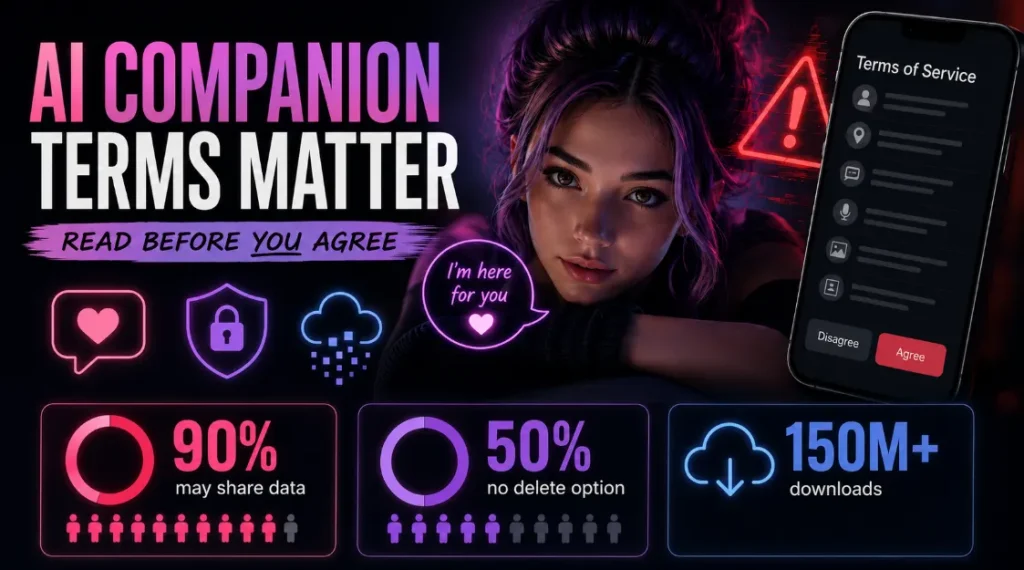
Mozilla's Privacy Not Included project audited dozens of AI companion and romance chatbot apps. The findings were grim: 90% of apps may sell or share user data for targeted advertising. More than half won't even let you delete the data they collected from you.
This isn't a niche problem. Apps in this category have been collectively downloaded over 150 million times on Android alone.
So yeah. The TOS matters here more than basically anywhere else.
⚙ What Data AI Companion Apps Collect From Users
This is the part most users genuinely do not expect.
When you sign up for an AI companion app, you're typically sharing far more than a username and email. Based on privacy policies across multiple platforms and independent security research, here's a realistic breakdown of what gets collected:
| Data Type | What It Includes |
|---|---|
| Account Info | Name, email, age verification, profile details |
| Chat Logs | Every message you've ever sent, yes, the filthy ones too |
| Images | Photos you upload or generate (including NSFW content) |
| Device Info | IP address, device type, browser, operating system |
| Location Data | Sometimes GPS, often country/region |
| Payment Info | Card details via third-party processors |
| Usage Patterns | Which features you click, how long you chat, what you explore |
| Sensitive Preferences | Sexual orientation, kinks, fetish preferences, relationship goals |
That last row is the one people always underestimate.
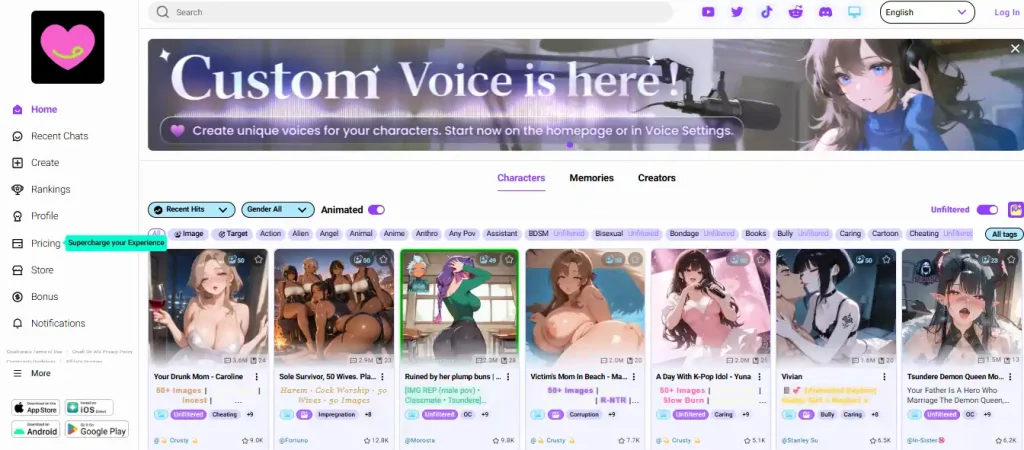
Some platforms like CrushOn.AI have been documented collecting details including sexual health information, medication use, and gender-affirming care data. These aren't edge cases, they're standard behaviour justified under “personalisation.”
A security firm called Surfshark found that the average AI companion app collects around 9 different data categories, with some collecting up to 15 distinct types.
To put that in perspective: most regular social media apps collect around 4–5.
📲 Hidden Trackers Inside AI Companion Apps Explained
Here's where it gets properly eyebrow-raising.
Trackers are tiny bits of code embedded in apps that silently send your data to third-party companies, advertisers, analytics firms, data brokers.
Mozilla researchers found that some AI companion apps fired thousands of trackers per minute. One app called Romantic AI triggered 24,354 trackers in just one minute of use.
The average across all apps tested? Around 2,663 trackers per minute.
These trackers are often sending data to Google, Facebook, and in some cases companies based in Russia and China.
The apps don't exactly put this in bold text on the homepage.
What's particularly cheeky is that the same apps often have warm, fuzzy marketing language about being your “safe space” or being there for “your mental health.” Then the TOS quietly says things like: “We are not a healthcare provider.” Romantic AI's own policies literally disclaim any responsibility for mental health outcomes, right after advertising themselves as mental health support.
💬 Are AI Companion Chats Really Secure in 2026?
Spoiler: not very, in many cases.
A 2026 security audit by Oversecured analysed 17 popular AI companion apps on Android and found 14 critical security vulnerabilities.
Ten of those apps gave hackers a direct path to users' private conversation histories.
For at least six apps, hackers could potentially access explicit conversations tied to real identities, the kind of content that makes for perfect blackmail material.
The founder of Oversecured said it bluntly:
The AI companion category handles a different but equally sensitive type of data as therapy apps, personal confessions, relationship details, sexual content. These apps grew so fast that basic security was never part of the process.This isn't ancient history either. In 2025, tens of millions of intimate messages and hundreds of thousands of photos were leaked from two AI girlfriend apps: Chattee Chat and GiMe Chat.
Most AI companion apps are not medical apps. They're not held to healthcare-level data security standards. They're not regulated in the same way. And the TOS usually reflects that, with indemnity clauses that basically say:
If something goes wrong with your data, that's on you.🌐 Who Can Read Your AI Companion Chat Data?
This one gets into murky territory fast.
The standard line in most privacy policies is:
We use your conversations to improve the AI and personalise your experience.That sounds reasonable on the surface. In practice, it means your sexual fantasies are potentially being read, analysed, and used to train future model versions.
Some platforms are more responsible about this than others.

Candy AI, for instance, states in its privacy policy that conversation data may be used to improve AI models, and handles payments through “Everai” (so it shows up discreetly on bank statements).
Their policy does not claim to sell personal data to third parties in the traditional sense. That said, data sharing with service providers, hosting companies, analytics platforms, and payment processors is still standard.
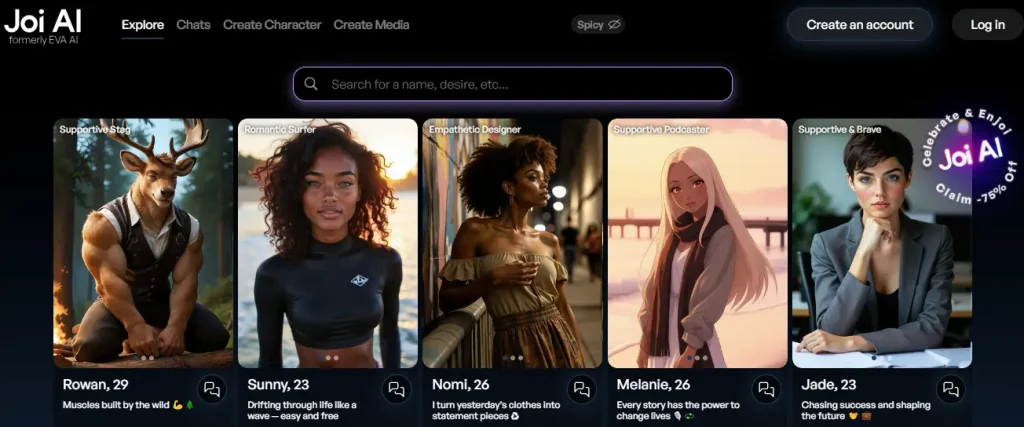
Joi AI earned a privacy rating of 3.8/5 in independent testing, reflecting a reasonable but not exceptional approach to data handling.
The general rule: the more emotionally intimate the platform, the more data it needs to function, and the more you should read the small print.
❓ Can You Really Delete AI Companion Chat Data?
A lot of users assume that if they delete their account, the data goes with it.
That's not how most of these platforms operate.
More than half of AI companion apps don't allow users to delete their own data, according to Mozilla's research. Even apps that do offer deletion often:
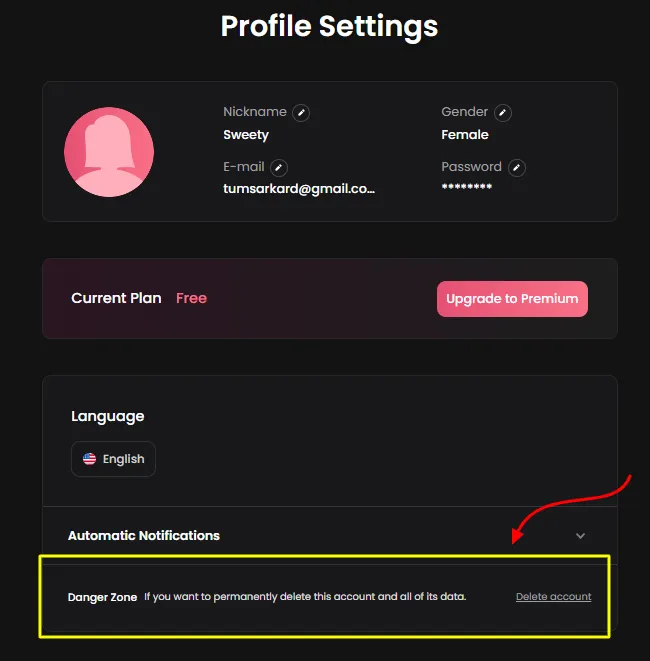
Candy AI is a good example of this last point: cancelling a subscription doesn't automatically delete your account. You have to make a separate, explicit data deletion request.
Many platforms also have vague wording around what “deletion” actually means. They may delete your account but keep anonymised conversation data. Whether your explicit messages are truly gone or just orphaned from your username is often unclear.
👀 Who Shares Your AI Companion Data Behind Scenes
Beyond the company itself, your data can travel further than you'd expect.
Here's the typical chain in most AI companion TOS documents:
That last point is often buried in two sentences near the bottom. If the startup behind your favourite AI girlfriend gets acquired by a larger company, which happens constantly in the AI space, your intimate chat history goes with it. You typically have no say in that.
Some platforms have specific policies around government data requests. Most promise to notify users before complying, unless legally prevented from doing so.
🖼️ AI NSFW Image Rights: What Terms Actually Say
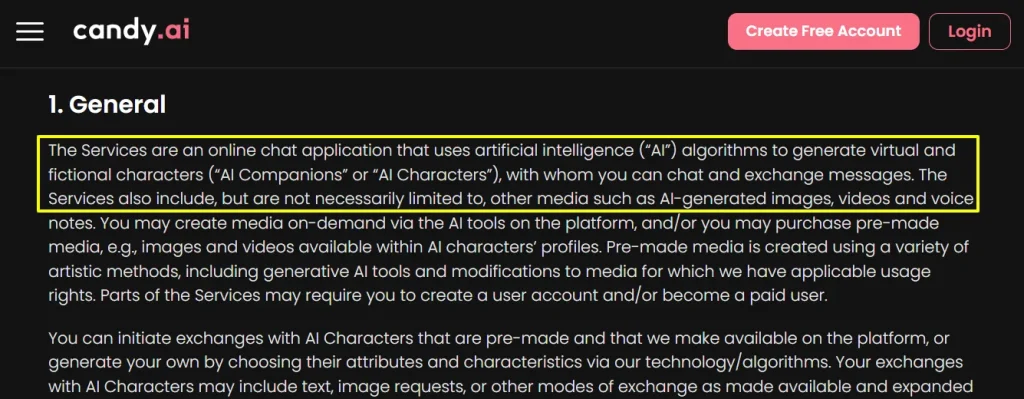
For platforms that support explicit AI-generated images, like Joi AI and Candy AI, the TOS gets extra interesting.
Most platforms claim ownership or licensing rights over AI-generated content created on their platform. This typically means:
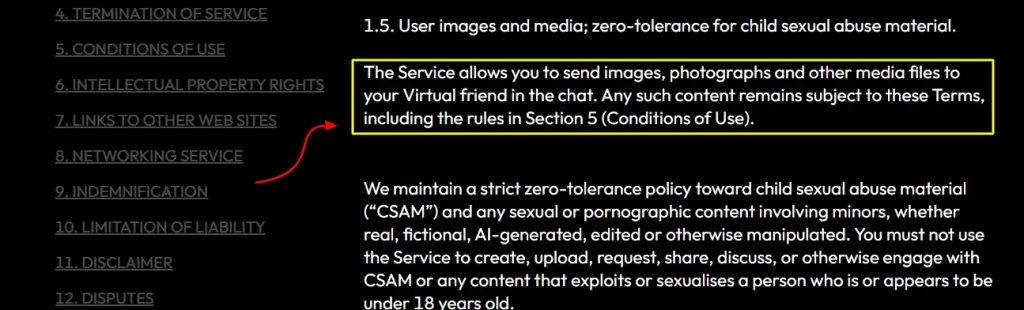
Joi AI, one of the stronger NSFW platforms around, with excellent character diversity, customisable fetish preferences, and top-tier image generation scoring 4.5/5, does have standard TOS language around generated content ownership.
What's worth noting is that these platforms exist in a grey zone. The EU's AI Act classifies most adult AI platforms as “low-risk,” which means less compliance burden but also fewer protections for users.
✅ AI Companion Age Verification Rules Explained
Nearly every AI companion app TOS says something along the lines of:
By using this service, you confirm you are 18 years of age or older.In practice, most don't verify this beyond a checkbox.
This is a known regulatory pressure point. Several jurisdictions, including parts of the EU and US, are pushing for actual age verification requirements for adult content platforms.
The TOS places the legal responsibility firmly on the user. If a minor accesses the platform and something goes wrong, the company's legal defence is: “They agreed they were 18.”
That's not a robust safeguard. It's a liability shield.
⚠️ Warning Signs in AI Companion Terms of Service
Before you sign up for any AI companion platform, run through this checklist:
Phrases like “with our partners and affiliates” with no further detail mean your data can go basically anywhere.
If the TOS doesn't explicitly describe how to delete your data, assume it stays forever.
Look for lines like “improve our services” or “train our AI systems.” This often means your messages are being used as training data.
If the privacy policy doesn't mention end-to-end encryption or encryption at rest, your chats are likely stored in plaintext.
Check if the app lists trackers or pixels in its policy. Most don't proactively disclose this.
If the app lets you use weak passwords with no enforcement, that's a signal that security wasn't a priority in development either.
“You may request deletion” is very different from “your data is deleted when you close your account.”
🔐 How Safer AI Companion Apps Handle User Data
Not every platform is equally reckless with your data. There's a meaningful gap between the worst offenders and the more responsible options.
Here's what separates the decent ones:
| Feature | What Good Looks Like | What Bad Looks Like |
|---|---|---|
| Data deletion | Clear process, prompt execution | No option or endless runaround |
| Billing discretion | Shows as unrelated company name | Platform name on bank statement |
| Chat storage | Disclosed retention period | Vague or never addressed |
| Third-party sharing | Named parties only | “Partners and affiliates” |
| Encryption | Explicitly mentioned | Not mentioned at all |
| Security audits | Referenced or certified | No mention |
| Model training consent | Opt-in or opt-out available | Buried default opt-in |
Candy AI scores reasonably well here, with discreet billing, no stated direct data sales, and clear signup processes.
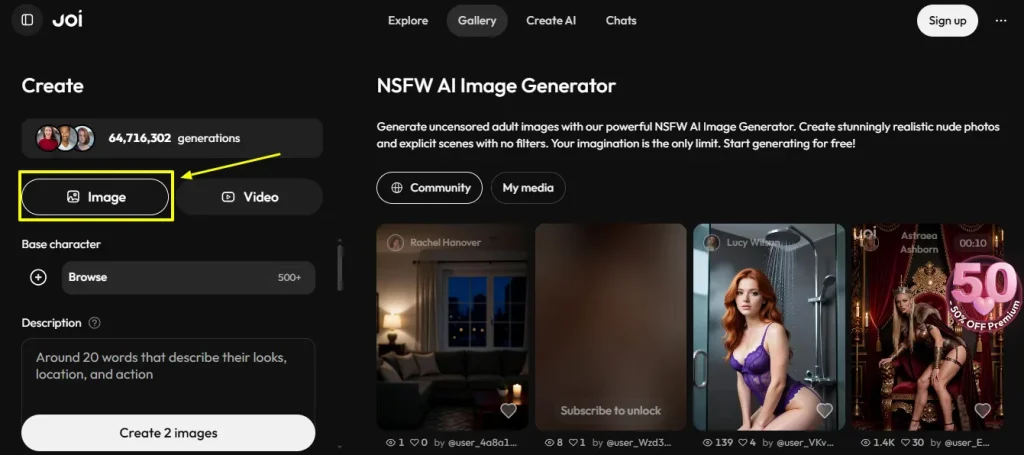
Joi AI offers a mature platform with genuine depth in its features, celebrity personas, NSFW image generation, voice packs, video loops, and while its privacy score isn't perfect at 3.8/5, it's transparent about its feature set and handles the adult content space with more seriousness than many competitors.
Neither is perfect. No AI companion app currently is. But both are materially better than many of the more obscure platforms flooding the market.
Joi AI Coupon – 50% OFF Private AI Experience
Unlock a safer, more transparent AI companion experience with Joi AI—use code HELLO50 to get 50% OFF on advanced features and privacy-focused interactions.

Use Code 🎁
HELLO50
🚨 AI Companion Privacy Risks for Indian Users
If you're using AI companion apps from India, there's an extra layer worth knowing about.
India's DPDP (Digital Personal Data Protection) Act and the SPDI Rules define sensitive personal data, which includes sexual orientation, financial information, and medical records.
The thing is: most AI companion platforms are not Indian companies. They're registered in the US, EU, or offshore. Which means DPDP enforcement is complicated, and your legal remedies are limited.
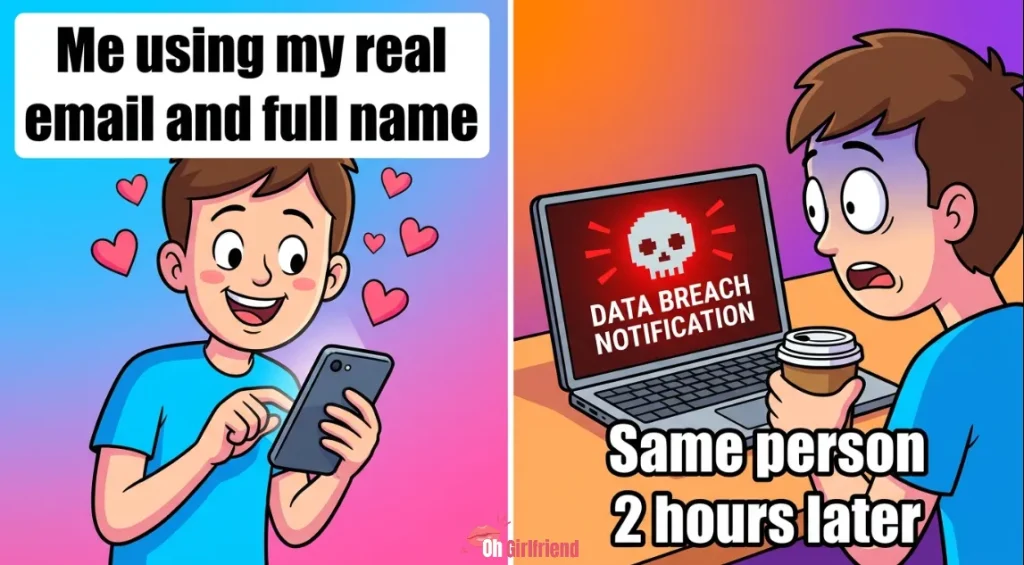
The practical takeaway for Indian users: never share anything genuinely identifying, no real name, no location, no photos of your actual face. Use a dedicated email address. Treat the platform like it's public, because in a breach scenario, it effectively is.
⚖️ Your Legal Rights With AI Companion Platforms
Depending on where you live, you may have more rights than you realise, even if the platform TOS tries to minimise them.
EU users (GDPR) have the right to:
UK users (UK GDPR) have similar rights post-Brexit.
US users are in patchwork territory. Some states (California, Colorado, Connecticut) have strong data rights. Others have nothing.
Indian users have rights under the DPDP Act, but enforcement against foreign platforms is still evolving.
The important thing: if you're in the EU or UK and an AI companion platform is not honouring deletion requests or access requests, you can file a complaint with your national data protection authority. That's a real mechanism with actual teeth.
💪 How to Stay Safe While Using AI Companion Apps
You don't have to quit AI companion apps entirely. You just have to be a bit smarter about how you use them.
Here's a practical protection checklist:
The platforms that earn trust are the ones that make this checklist easy to pass. The ones that fail it are telling you something important about their priorities.
🎯 Future Laws for AI Companion Privacy and Safety
The AI companion market is growing fast and regulation is playing catch-up.
There's genuine momentum right now toward proper legislative frameworks for romantic and adult AI chatbots, both in the US and EU. Laws being introduced in 2025–2026 are specifically targeting companion chatbots, requiring things like disclosures around sexually explicit content generation and age verification systems.
But until that regulation actually lands and has real enforcement teeth, the TOS is the only contract between you and the platform.
And right now, that contract is written almost entirely in the platform's favour.
The smartest thing you can do is treat every AI companion interaction as potentially permanent, potentially visible, and potentially shareable, not because you're paranoid, but because the TOS of most platforms essentially says it can be.
Use the good platforms. Read the boring pages. Protect your actual identity.
The fantasy is fun. The data collection is very real.

More From OhGirlfriend

Lucas – your go-to wingman in the world of AI girlfriends and virtual flings. From testing voice moans and NSFW chatbots to rating roleplay realism and emotional depth, he’s tried everything so you don’t have to. Whether you’re chasing a cute cuddle bot or a full-on spicy fantasy AI, Lucas gives you the no-filter lowdown on who’s worth your time (and your late nights).
Affiliate Disclosure: This post may contain some affiliate links, which means we may receive a commission if you purchase something that we recommend at no additional cost for you (none whatsoever!)