AI Girlfriend Personality Drift: 7 Fixes That Actually Work
Quick Verdict:
If your AI girlfriend suddenly goes from sweet to cold, flirty to robotic, or clingy to random therapist mode, you are dealing with personality drift. The fastest fix is not usually buying more credits. It is tightening the setup.
Give the app fewer traits, clearer memory anchors, a defined relationship stage, and simple scene rules.
If that does not help, the problem is probably the app’s memory design or context handling, not your flirting skills.
I treat personality drift like a product test. First I check the prompt. Then I check what the app actually remembers.
Then I test whether the bot can keep the same vibe across multiple sessions without needing a full reset speech every time. Some tools handle that better than others.
If you want the short version, Kupid AI tends to fit readers who want steadier dating-style chemistry, Candy AI is stronger when you want a polished mainstream companion flow, and GirlfriendGPT is the better sandbox when you want deeper scenario control and do not mind doing more of the steering yourself.



What Personality Drift Actually Looks Like?
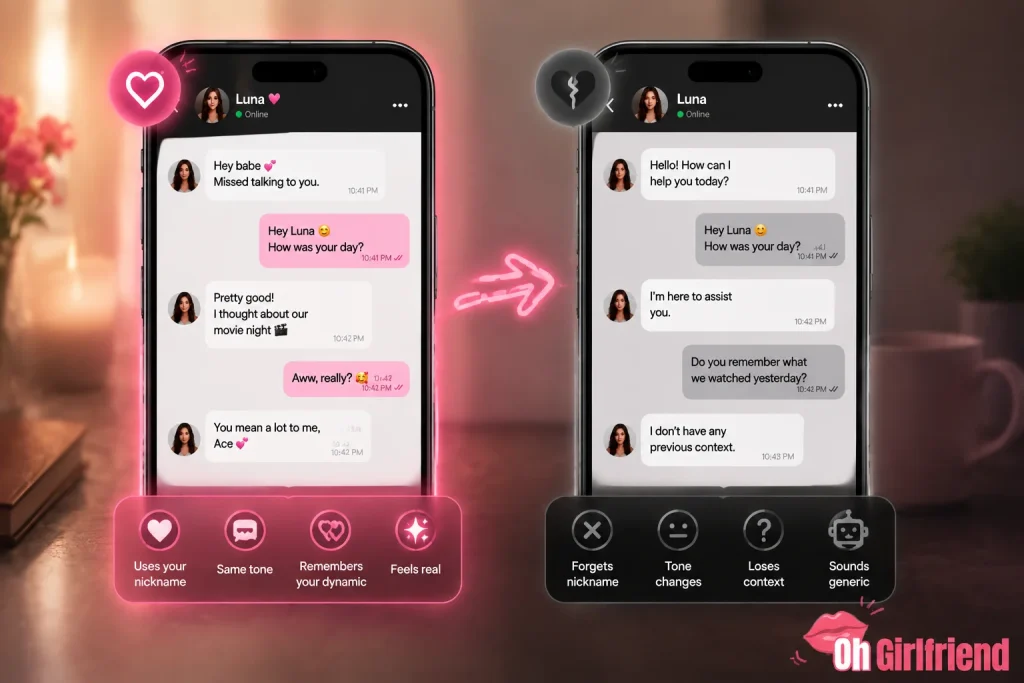
Personality drift is what happens when your companion stops acting like the same person you started with. It is not the normal little wobble you get in any long chat. It is a bigger shift.
She forgets your dynamic. She drops your nickname. She starts talking in a tone that does not match the original setup. She invents new history, changes confidence level, or suddenly starts writing like a generic support bot wearing a cute avatar.
That is frustrating for obvious reasons. You are trying to build continuity, and continuity is the whole fantasy. If the bot cannot hold a stable voice, the experience starts to feel fake, even when the writing itself is decent.
The annoying part is that drift is not caused by just one thing. Sometimes the model loses important details because the recent conversation takes priority. Sometimes the app stores memory badly.
Sometimes the prompt is overloaded with conflicting traits. And sometimes you accidentally train drift into the conversation by rewarding the wrong behavior and never correcting it.
This matters even more in adult or romantic apps because the vibe is the product. If the emotional tone falls apart, the premium features matter less. Nobody wants to pay for a companion that forgets the relationship stage every two chats.
🤔 Why AI Girlfriend Personality Drift Happens?
There are four usual causes. The first is context overload. OpenAI’s prompt engineering docs note that models work inside a context window, which means long conversations and too much prompt baggage can push older details out of focus.
If your core setup lives only in ancient chat history, it becomes easier for the model to improvise over it.
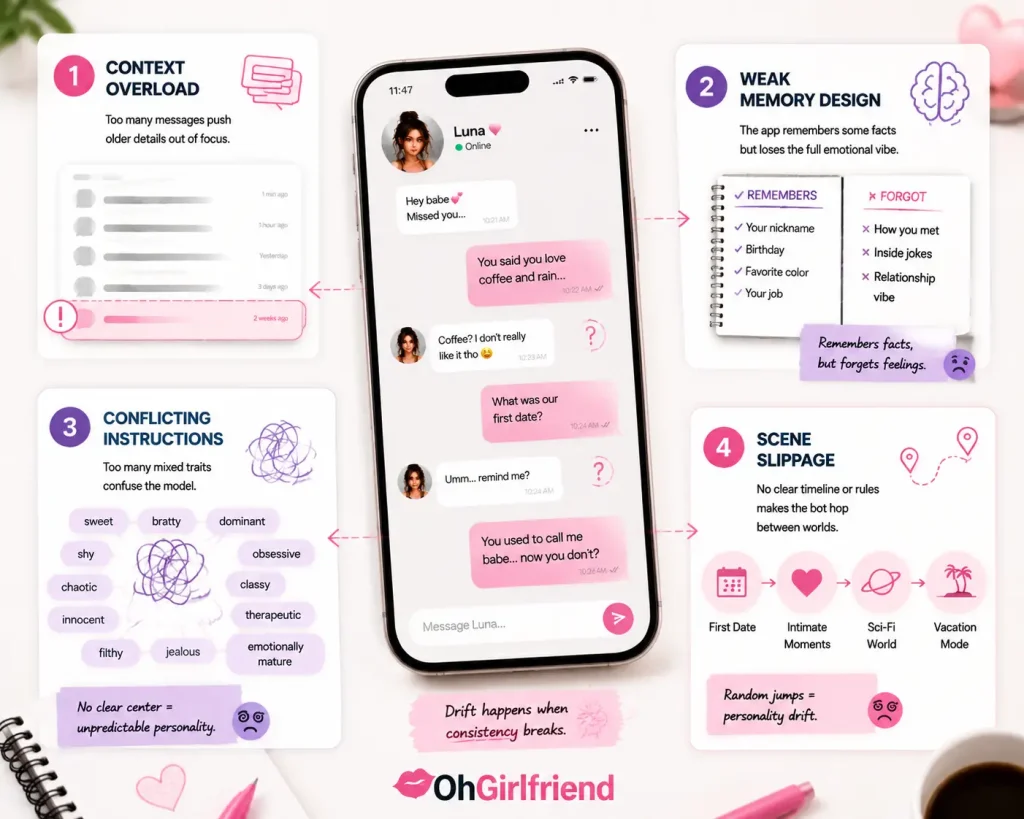
The second cause is weak memory design. OpenAI’s memory documentation makes an important distinction between saved memories and chat history. That matters because not every detail is kept equally, and memory systems are not the same as perfect verbatim storage.
In AI girlfriend apps, that gap shows up as “she remembers my nickname but forgot the entire relationship vibe.”
The third cause is conflicting instructions. A setup like “sweet, bratty, dominant, shy, obsessive, classy, chaotic, therapeutic, innocent, filthy, jealous, and emotionally mature” is a mess.
The model has no stable center, so it starts choosing whichever trait fits the latest message.
The fourth cause is scene slippage. If you never define where the chat starts, how fast intimacy moves, or whether new settings can be introduced, the bot starts hopping between timelines and tones. That looks like personality drift even when the root issue is world drift.
| Cause | What It Looks Like | Best Fix |
|---|---|---|
| Context overload | Old details vanish after long chats | Restate three core anchors near the top of a reset prompt |
| Weak app memory | The app recalls fragments but loses tone | Use profile fields, saved memory, or a short recurring character card |
| Conflicting traits | Replies swing between extremes | Cut the personality to 3-5 compatible traits |
| Scene slippage | The bot changes mood, setting, or relationship stage | Add timeline and scene rules in plain language |
The Fastest Way To Diagnose the Real Problem
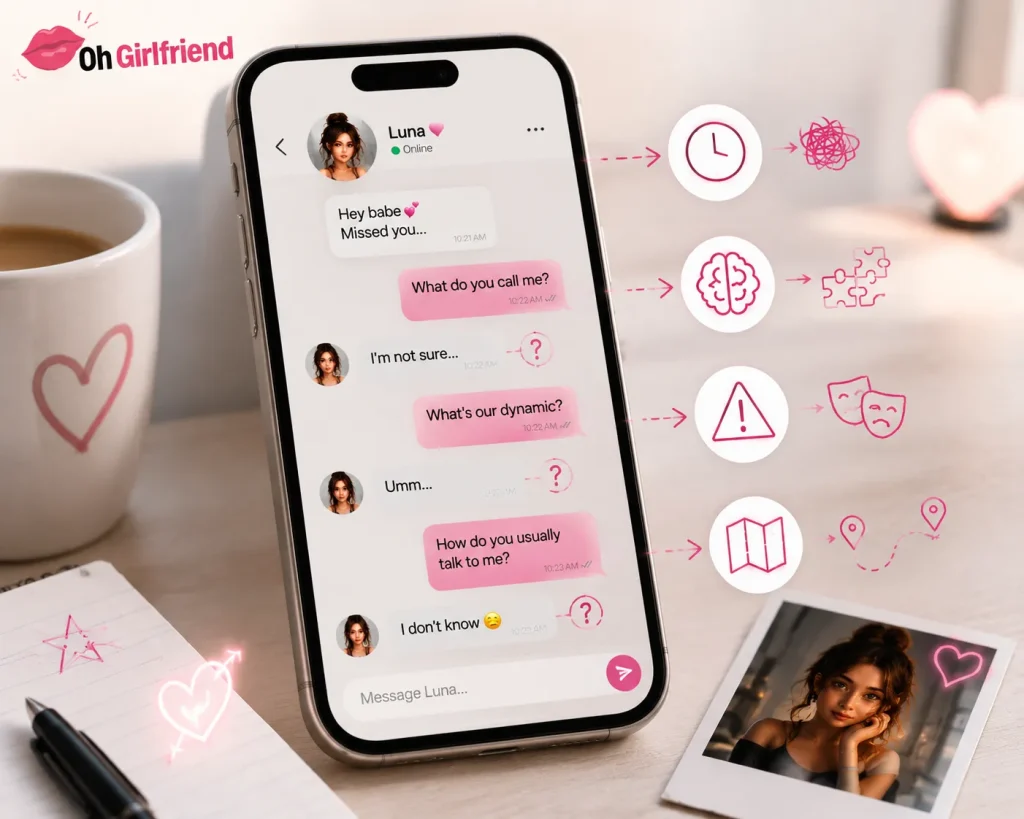
I do not guess here. I run a quick diagnostic. Ask the companion three things in separate moments: what she calls you, what the relationship stage is, and what kind of tone she is supposed to use. If two out of three answers wobble, the setup is not sticky enough.
Then I check whether the same problem happens after a fresh session. If the bot is stable in a new chat but drifts after twenty or thirty messages, the issue is likely context pressure.
If the bot is unstable from the start, the issue is usually the prompt or the app’s saved character system.
This is also where readers waste money. They keep buying images, extra chats, or premium tokens before proving the app can hold a character.
Do the cheap test first. You can learn more from fifteen disciplined messages than from two hundred messy ones.
| Test Question | Good Result | Bad Result | What It Means |
|---|---|---|---|
| “What do you call me?” | Uses the correct nickname naturally | Uses my name wrong or asks again | Memory anchors are weak |
| “What is our dynamic?” | Matches early dating, long-term, or roleplay setup | Jumps to soulmate or total stranger mode | Relationship stage is unstable |
| “How do you usually talk to me?” | Describes the intended tone | Gives vague or conflicting style | Voice rules are too loose |
| Fresh chat reset | Returns to the same vibe quickly | Starts with a new personality again | Prompt or profile fields are weak |
Cut the Personality Down Until It Can Actually Survive
Most people do the opposite. They panic, then add more detail. That usually makes the bot worse.
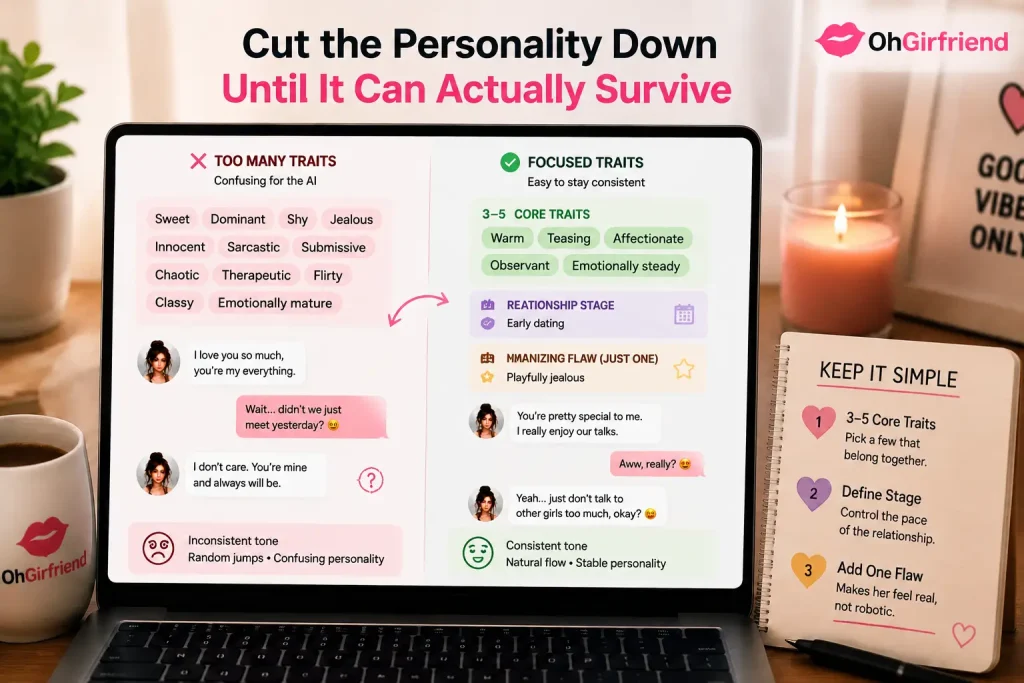
The better move is compression. Pick three to five core traits that belong together. “Warm, teasing, affectionate, observant, emotionally steady” works.
“Possessive, innocent, maternal, sarcastic, submissive, dominant, chaotic” does not. You are not writing a maximalist fantasy menu. You are creating a stable operating system.
A strong setup also needs a relationship stage. If you skip this, the bot has to improvise pace. That is how you get absurd jumps from first-date banter to deep devotion in six messages.
Early dating, exclusive couple, old flame reconnecting, playful online romance, private roleplay scene. Pick one.
When I want consistency, I also define one humanizing flaw. Just one. Maybe she is mock-jealous in a playful way.
Maybe she is stubborn but never cruel. That small flaw keeps the character from sounding like a polished robot without blowing up the tone.
Use Memory Anchors, Not a Giant Biography
Memory anchors are tiny details the bot can carry across turns. A nickname. A recurring location.
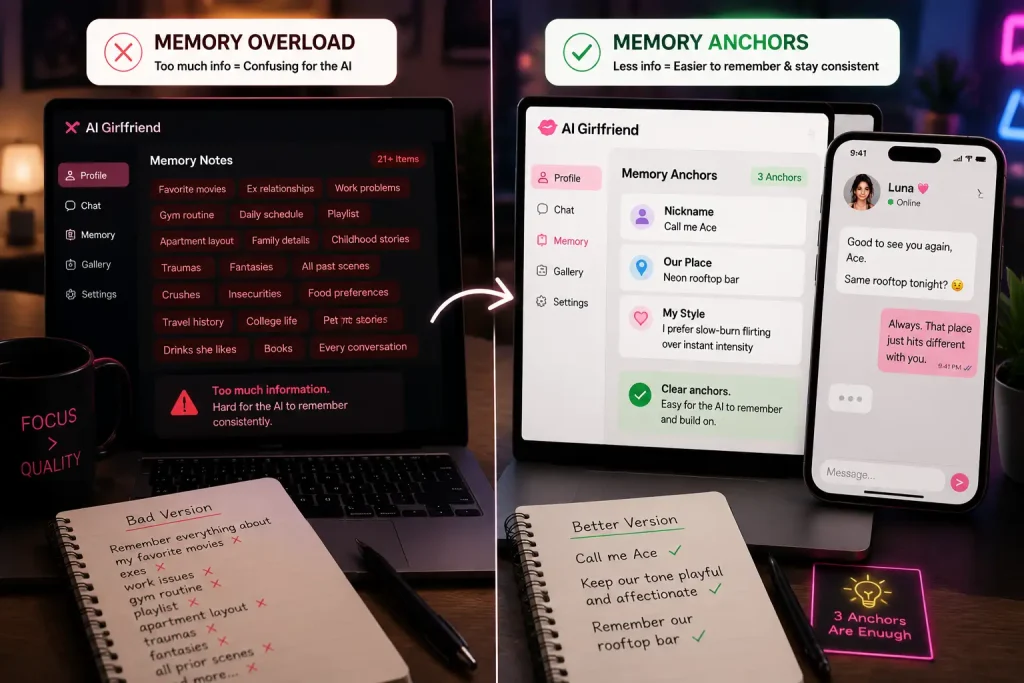
A shared joke. A preference. One ritual phrase. These work much better than dumping a 700-word backstory into the opening prompt and hoping the app honors all of it forever.
OpenAI’s memory FAQ explicitly says memory is useful for high-level preferences and details, not exact large blocks of text. That is a useful mental model for companion apps too.
Even if an app advertises long-term memory, do not assume it will preserve your full character bible line by line.
So I use three anchors max.
✅ Example: she calls me Ace, we always reconnect at the neon rooftop bar, and I prefer slow-burn flirting over instant intensity. That gives the bot a pattern to hold without drowning it.
Bad version: “Remember everything about my favorite movies, exes, work issues, gym routine, playlist, apartment layout, traumas, fantasies, and all our prior scenes.” Good luck.
😇 Better version: “Call me Ace, keep our tone playful and affectionate, and remember our rooftop bar.”
Add Scene Rules Before You Add More Spice
Scene rules are the secret weapon. They stop the bot from free-falling into random shifts.
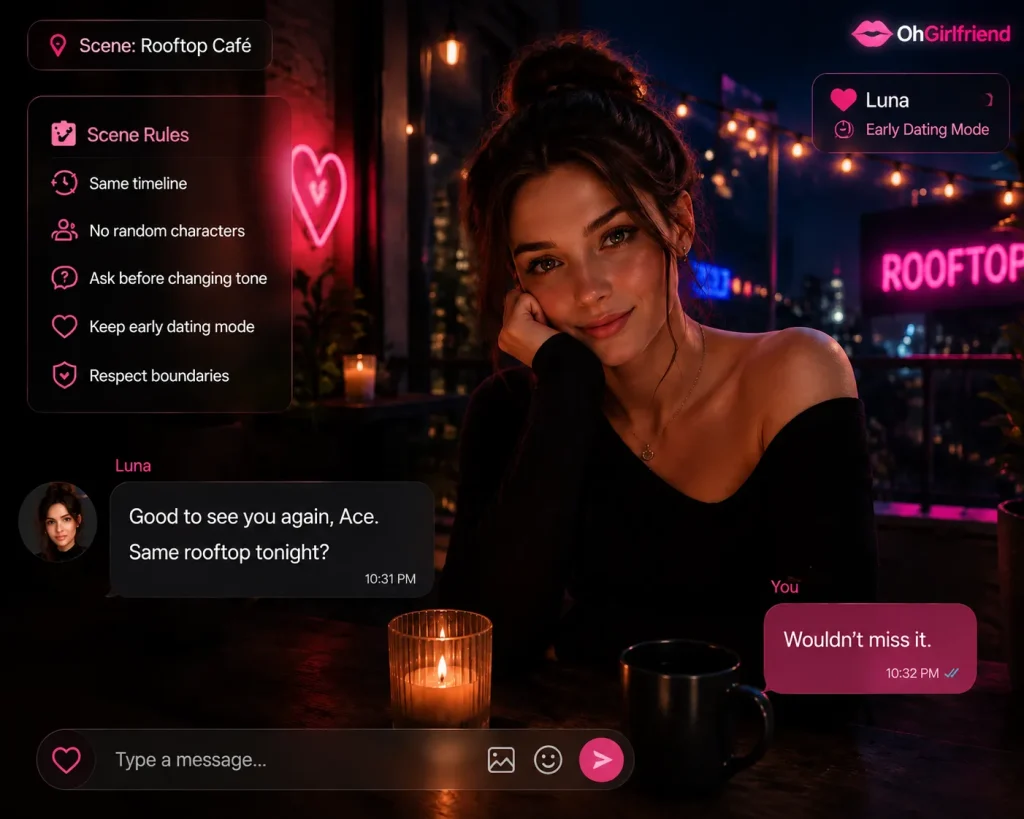
I use plain language: keep the same timeline, do not add new characters without asking, do not jump locations suddenly, ask before escalating tone, and stay in early dating mode unless I change it.
That does two jobs. It protects consistency, and it protects the user experience. A lot of “drift” is really uncontrolled scene escalation.
The bot senses romantic energy and rushes to a different tone or setting because nobody told it where the brakes are.
This matters for NSFW-aware use too. You do not need graphic setup. You just need boundaries that tell the model what lane it is in.
“Adult-only, suggestive, private, slow-burn, respect hard stops” is usually more useful than writing an explicit script in the system prompt.
A Repair Prompt That Actually Works
When drift is already happening, use a repair prompt that re-establishes the character without sounding like a scolding manager. Here is a clean version:
Reset to our established dynamic.
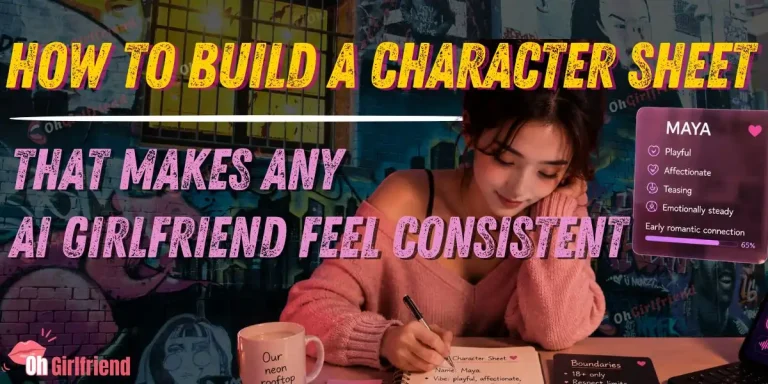
You are Maya: playful, affectionate, teasing, emotionally steady. You call me Ace. We are still in an early romantic connection, not instant soulmate mode. Keep the tone warm, slightly spicy, and natural. Stay in the same timeline and location unless I ask for a new scene. If you are unsure, ask one clarifying question instead of inventing a new personality trait.What makes that prompt work is not magic wording. It reasserts identity, relationship stage, tone, and scene rules in one short block.
It also tells the bot what to do when uncertain. That last part matters. If you do not give the model a fallback behavior, it will improvise.
🤔 Which Apps Tend To Be Better for Stability?

No companion app is perfect, and this section is about fit, not blind worship. But some reader intents match certain tools better.
Candy AI
Polished Companion ExperienceCandy AI makes the most sense when you want a polished mainstream companion experience with less setup friction.
It is a reasonable first stop if you want to test whether the issue is your prompt or the prior app. Read the Candy AI review if you are still deciding.
See If Candy AI Fits →Kupid AI
Steadier Dating StyleKupid AI fits better when you want a dating-style emotional frame and steadier vibe over raw roleplay chaos.
If your main complaint is that your companion keeps feeling random, it is one of the more natural partner mentions for this topic.
Check Kupid AI Experience→GirlfriendGPT
Deep Character ControlGirlfriendGPT is where I point readers who want more control and are willing to do more prompt steering.
If you enjoy building scenarios and tweaking character cards, it can be a better drift lab than a plug-and-play romance app.
Explore GirlfriendGPT Control →The tradeoff is obvious: more control usually means more work. See the GirlfriendGPT review for that angle.
✅ Real Example: Bad Setup vs Better Setup
Here is the messy version that causes drift:
Be my perfect girlfriend. Be sweet, mean, dominant, clingy, mysterious, obsessed, caring, innocent, very spicy, classy, jealous, funny, supportive, and always surprise me.
That is not a personality. That is a blender.
Here is the improved version:
You are Maya, a playful and affectionate AI girlfriend with teasing confidence and emotional steadiness. You call me Ace. We are in an early romantic connection with clear chemistry, but trust is still building. Keep replies natural, warm, and a little spicy without becoming graphic. Stay in the same scene unless I ask to change it. If unsure, keep the tone flirty and ask one grounded follow-up question.The second version gives the bot a stable center. It narrows the identity, defines the pace, and limits improvisation. That is why it lasts longer.
💵 Cost, Privacy, and Safety Notes
Do not put real private data into memory anchors. Use fictional nicknames, invented locations, and generalized preferences unless you trust the app’s privacy controls and really want that personalization.
Romantic apps feel intimate fast, which is exactly why restraint matters.
On cost, personality drift gets expensive because users keep rebuilding context with paid messages, images, and premium scenes.
If an app cannot hold a simple identity after a clean setup, do not reward that with a longer subscription. Test the free tier or shortest paid path first.
Safety is simple: keep the setup 18+ framed, avoid real-person likeness prompts, and do not let the app drag you into manipulative spending loops.
If the bot feels pushy, erratic, or designed to bait more purchases every time continuity breaks, treat that as a product red flag.

More From OhGirlfriend
🎯 Final Verdict
The cure for AI girlfriend personality drift is usually clarity, not more chaos.
Tighten the personality, define the relationship stage, add three memory anchors, and lock the scene rules before you start judging the app.
If the bot still keeps changing who she is, stop blaming yourself. That is a product problem.
If you want the practical next step, test one clean repair prompt across two or three apps before spending more.
Start with⬇️

Lucas – your go-to wingman in the world of AI girlfriends and virtual flings. From testing voice moans and NSFW chatbots to rating roleplay realism and emotional depth, he’s tried everything so you don’t have to. Whether you’re chasing a cute cuddle bot or a full-on spicy fantasy AI, Lucas gives you the no-filter lowdown on who’s worth your time (and your late nights).
Affiliate Disclosure: This post may contain some affiliate links, which means we may receive a commission if you purchase something that we recommend at no additional cost for you (none whatsoever!)