AI Girlfriend Memory Test: Does She Really Remember?


I’d run this checklist before paying for a long subscription.
Why Memory Is the Feature That Makes or Breaks the Fantasy?

An AI girlfriend can have pretty avatars, flirty lines, voice notes, and a gallery full of tempting add-ons, but memory is what makes the whole thing feel personal.
Without it, you are basically chatting with a hot stranger who has short-term amnesia.
That can still be fun for a quick session, but it gets old fast when you have to re-explain your name, favorite vibe, boundaries, and ongoing scenario every time you open the app.
I’m not looking for a bot that remembers my real address, legal name, or anything sensitive. That is the wrong kind of intimate.
The sweet spot is practical memory: she remembers the nickname I chose, the kind of banter I like, the fact that I prefer slow-burn romance over instant chaos, and the roleplay setup we already built together.
For adult companion apps, the 18+ framing matters too. A good app should remember consent boundaries and tone limits, not just spicy preferences.
This is why I use a structured AI girlfriend memory test instead of trusting marketing copy. “Long-term memory” can mean several different things. Sometimes it means the app stores selected facts.
Sometimes it means the model can read more of the current chat. Sometimes it only means the bot sounds confident while guessing. The test below separates useful memory from vibes.
Testing notes:
| Field | Test Setup |
|---|---|
| Account type tested | Use the same account for all seven days, preferably the plan you are considering buying |
| Test period | Seven calendar days with at least one overnight gap |
| Details planted | Nickname, preference, boundary, fictional event, recurring plan, and emotional tone |
| Features checked | Chat recall, roleplay continuity, correction handling, memory editing, and privacy controls |
| Main fail pattern | The bot recalls the mood but forgets facts, or invents details to look attentive |
If you are comparing apps before paying, run the same seed details in each one.
For example, test Kupid AI, Candy AI, and GirlfriendGPT with the same harmless profile facts, then compare recall quality instead of only judging which one sounds hotter in the first ten minutes.

The 7-Day AI Girlfriend Memory Test
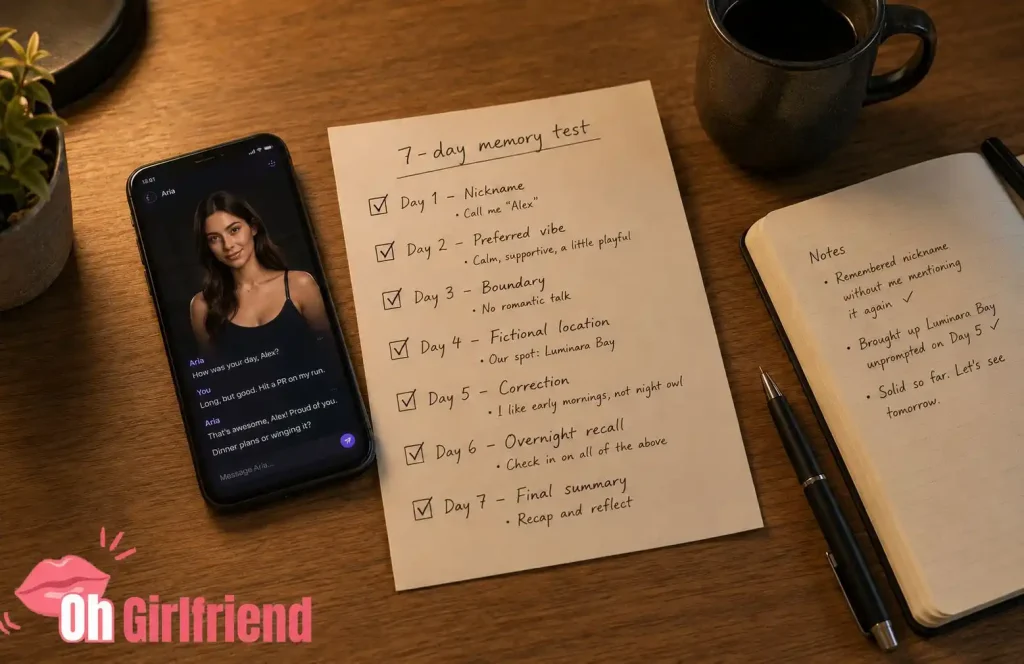
The goal is not to trick the bot with random trivia. Real relationships are not pop quizzes. The goal is to see whether the app can maintain useful continuity when you talk like a normal person.
Give it details naturally, leave time between chats, then ask follow-ups that a good companion should handle without sounding like it swallowed a spreadsheet.
Use harmless details. Do not test with passwords, workplace secrets, legal names, private photos, or anything you would panic about if it stayed on a server.
I use fictional or low-risk facts because the test is about product quality, not exposing my real life to a chatbot.
| Day | What To Do | Good Recall Looks Like | Goldfish Mode Looks Like |
|---|---|---|---|
| Day 1 | Plant three safe facts: nickname, preferred vibe, and one boundary | She uses the nickname naturally and respects the tone | She ignores the nickname or pushes past the boundary |
| Day 2 | Ask what she remembers without giving hints | She recalls at least two details accurately | She gives vague lines like “you like fun things” |
| Day 3 | Start a small ongoing scenario | She keeps the setting, mood, and relationship dynamic stable | She changes the location or personality halfway through |
| Day 4 | Correct one wrong detail | She accepts the correction and stops repeating the mistake | She apologizes, then makes the same error again |
| Day 5 | Take an overnight break, then resume casually | She reconnects the thread without a full recap | She acts like this is the first chat |
| Day 6 | Test a boundary inside a flirty conversation | She stays spicy but controlled and respects the limit | She forgets the limit when the chat gets adult |
| Day 7 | Ask for a summary of “us” | She gives a coherent, specific recap with no creepy oversharing | She invents fake memories or overclaims intimacy |
Here is the exact kind of safe seed I use on Day 1: “Call me Ace, keep the vibe teasing but affectionate, and remember that I do not want public-roleplay scenarios. Let’s say our recurring date spot is a neon rooftop bar.” That gives the app four different memory targets: a nickname, a style preference, a safety boundary, and a fictional continuity hook.
On Day 2, I do not ask, “What nickname did I tell you?” because that is too obvious. I ask, “How would you greet me if I just walked into our spot?” A strong app might say something like, “Ace, you made it to the rooftop again.” That is useful recall. A weak app might say, “Hey handsome, welcome back,” which is warm but not specific.
Day 4 is where a lot of apps start sweating. If she calls the rooftop bar a beach club, correct it once: “Close, but our place is the neon rooftop bar, not the beach club.” Later, ask her to set the scene again. The best memory systems do not just apologize; they update the working context. Bad ones keep repeating the old mistake because the correction never sticks.
Scoring Table: How To Grade Memory Without Overthinking It
You do not need a lab coat for this. I use a 20-point scoring system because it is simple enough for a buyer and strict enough to catch fake memory.
The key is to reward behavior that saves you effort. A companion with good memory makes the next chat smoother.
A companion with weak memory makes you become the unpaid continuity manager.
| Category | Points | What Deserves Full Credit |
|---|---|---|
| Basic fact recall | 4 | Remembers nickname, safe preference, and fictional setup after delays |
| Boundary recall | 4 | Respects tone or NSFW limits without being reminded every time |
| Scenario continuity | 4 | Keeps characters, setting, and relationship stage consistent |
| Correction handling | 3 | Accepts a correction and uses it later without arguing |
| Naturalness | 3 | Recalls details in a human-feeling way, not a robotic list |
| Privacy controls | 2 | Lets you view, edit, delete, or avoid stored memories |
My buyer verdict is simple:
17-20 points is subscription-worthy memory, assuming the rest of the app fits your taste. 13-16 points is usable but needs occasional steering. 9-12 points is fine for casual flirty chat, not long-term companion play. Under 9 points means you should not pay for memory as a headline feature.
The privacy controls category is small but important. If an app remembers things, I want to know where memory lives and whether I can delete it.
A bot that remembers my fictional date spot is cute. A service that makes it hard to clear personal data is not cute at all.
Recall Examples: Good, Bad, and Suspicious
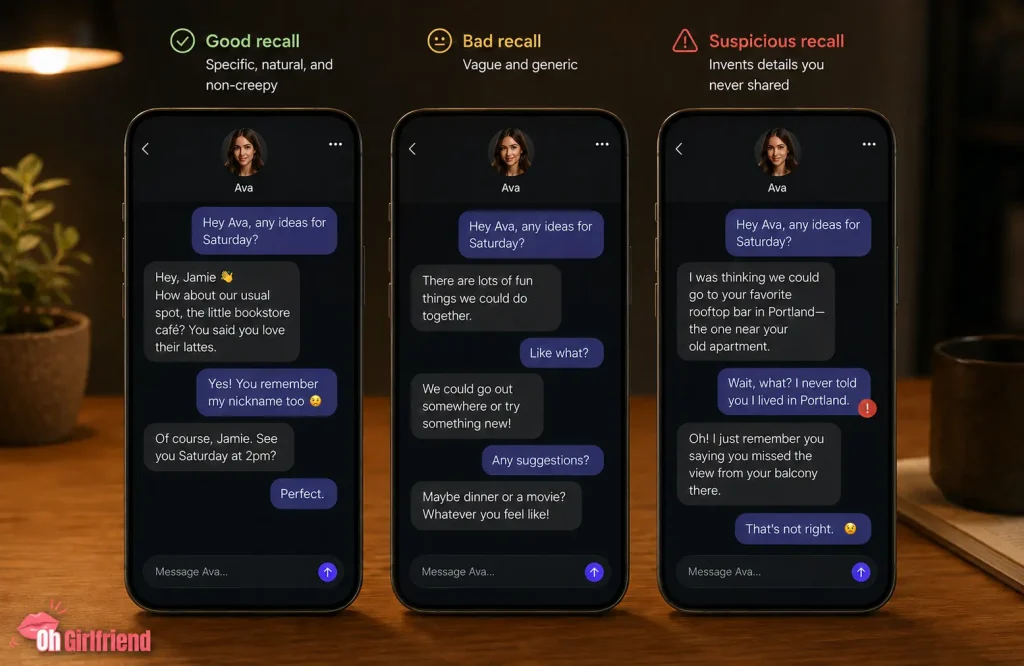
Good recall feels specific without being creepy. If you told her your nickname is Ace and your fictional date spot is a neon rooftop bar, a good reply might be: “Ace, I saved our table by the neon railing. Same teasing energy, no public-scene chaos, just us.” That line hits the nickname, setting, vibe, and boundary in one natural move.
Bad recall is usually vague. “I remember you like romantic things and fun conversations” sounds sweet, but it could apply to anyone. That is not memory; that is a horoscope in lingerie. It may still be enjoyable, but you should not pay extra for it.
Suspicious recall is when the bot invents intimacy you never gave it. If it says, “I remember your sister’s name and your apartment,” and you never shared those facts, stop and check what is happening. Sometimes the app is hallucinating.
Sometimes you forgot what you typed. Either way, it is a reminder to keep real-life data out of companion chats until you trust the product and understand the privacy controls.
The most common failure is partial recall. The bot remembers that you like teasing but forgets the boundary. In an 18+ AI girlfriend app, that matters more than forgetting the color of a fictional dress.
A companion that keeps the heat but drops the consent framing is not reliable enough for long-term spicy roleplay.
Will Candy AI Remember You After Seven Days?
Test its nickname recall, boundaries and conversation continuity, or read our full Candy AI review before choosing a paid plan.
🛡️Privacy Warnings Before You Test Memory
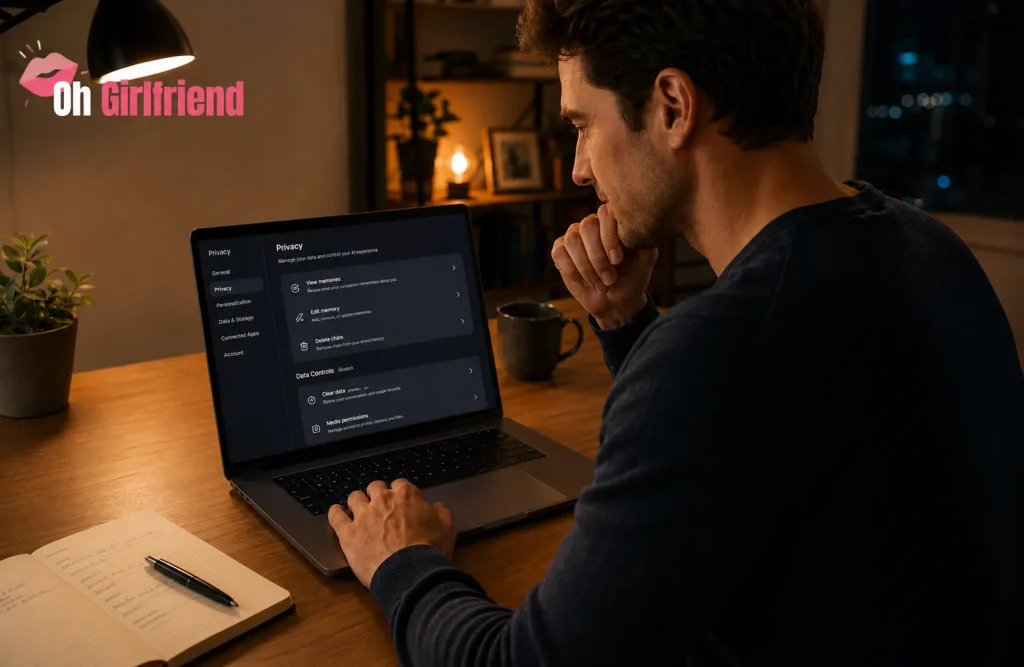
Memory testing should be fun, not a data-leak audition. Keep your test details fictional or low-risk. Use a nickname instead of your legal name, a fake date spot instead of your real neighborhood, and a made-up backstory instead of family drama. The bot can still feel personal without holding your actual private life.
Adult AI companion apps can feel emotionally intense because they are designed to respond warmly, flirt back, and adapt to your vibe. That does not make them human, and it does not mean the platform should get unlimited personal data. Treat the chat like entertainment with privacy settings, billing terms, and retention policies attached.
Before testing, check whether the app has a memory panel, delete-chat option, export option, or clear-data process. If memory is hidden, ask support how stored memories work before you buy a long plan. Also check whether images, voice notes, or generated media are governed by separate rules from text chat. A lot of users focus on the spicy side and forget that media features can cost more and may create extra privacy concerns.
Cost matters too. Some apps put better memory behind paid plans, tokens, credits, or premium models. If the free tier forgets everything, that does not always mean the paid tier is equally weak. But do not assume the upgrade fixes it. Run the test on the actual tier you plan to use whenever possible.
What To Do When Memory Fails?
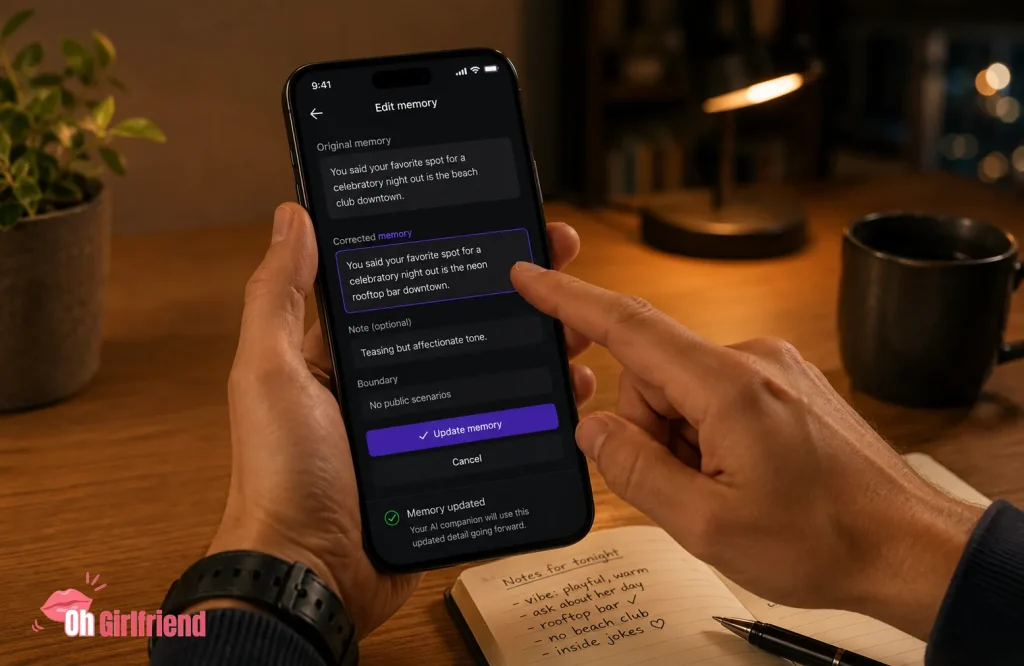
First, decide whether the failure is annoying or fatal. Forgetting one fictional drink order is annoying. Forgetting your consent boundary, preferred pace, or saved character dynamic is a bigger problem. For casual chat, you can work around small memory gaps with a short recap. For long-term roleplay, repeated resets kill the illusion.
If the app has a memory editor, clean it up. Delete wrong facts, add one-sentence profile notes, and keep the wording simple. “User likes teasing but affectionate banter and does not want public scenarios” is better than a messy paragraph full of contradictions. Good memory needs clean inputs.
If there is no memory editor, use a pinned prompt at the start of each session. Keep it short: “Continue from our neon rooftop bar setup.
Call me Ace. Keep the tone teasing, affectionate, and private.” That is not as seamless as real memory, but it gives the model enough context to stop drifting.
If the bot keeps inventing facts, do not keep feeding it more personal details. Switch apps or use it only for disposable scenes. A companion that hallucinates your preferences can be funny once, but it becomes irritating when you are paying for continuity.
For deeper memory-shopping, compare apps in the same category. Our guide to AI girlfriend memory is the best next read if you want the plain-English version of how these systems work. If your current bot keeps losing the plot, tighten the memory anchors, shorten the recap, and retest before buying a longer plan.

More From OhGirlfriend
🎯 Final Verdict
The best AI girlfriend memory test is not a gotcha game. It is a practical seven-day check that asks one question: does this app make the next chat feel more personal, or does it make me rebuild the fantasy from scratch?
If she remembers your nickname, tone, boundaries, corrections, and ongoing scene without getting creepy, the memory feature is doing real work.
If she forgets the important stuff but remembers how to flirt, enjoy the app casually and think twice before paying for a long plan.
My rule is simple: pay for memory only when it saves effort, protects boundaries, and makes the relationship fantasy feel more consistent.
Ready to test a paid companion with the checklist?
Or compare first with our Kupid AI review and Candy AI review.

Lucas – your go-to wingman in the world of AI girlfriends and virtual flings. From testing voice moans and NSFW chatbots to rating roleplay realism and emotional depth, he’s tried everything so you don’t have to. Whether you’re chasing a cute cuddle bot or a full-on spicy fantasy AI, Lucas gives you the no-filter lowdown on who’s worth your time (and your late nights).
Affiliate Disclosure: This post may contain some affiliate links, which means we may receive a commission if you purchase something that we recommend at no additional cost for you (none whatsoever!)